Quick verdict
For a skinny kitchen island under 18 inches deep, reserve the island's depth plus the space needed to stand, open storage, and move around the ends. A cart that fits against the wall can still make the kitchen unusable once a drawer, door, or drop leaf is open.
A shallow rolling cart is usually safer than a fixed island when the room has a changing layout. If you need a real prep surface, look for a compact cart with a depth around 13 to 16 inches and verify the full width, caster footprint, and open-door clearance. Treat anything near 18 inches as the maximum, not the target.
Measure this before buying
- Closed footprint: measure the island's maximum depth and width, including the top, side rails, handles, casters, towel bars, and any leaf hardware that projects beyond the cabinet.
- Working aisle: measure the clear passage between the island and the nearest counter, appliance, wall, or table. Check the narrowest point rather than relying on the room's average width.
- Open-door clearance: open the refrigerator, oven, dishwasher, cabinet doors, and the island's own drawers. The island must not sit inside a door swing or leave you trapped between two open surfaces.
- End clearance: leave room to walk around the island ends and to pull it out if it has casters. A narrow island that touches a wall can still be difficult to reposition.
- Counter height and overhang: compare the worktop height with your counters and measure any overhang. A top that extends beyond the base changes both the footprint and the walkway.
- Floor and caster path: check thresholds, uneven tile, rugs, baseboards, and cabinet feet. Locking casters help the cart stay put, but they do not make a bump or slope disappear.
- Outlet and appliance clearance: keep plugs, cords, vents, and appliance doors accessible. Do not use a mobile island to block a required ventilation or service area.
Recommended Amazon products to check
These examples cover shallow prep carts and slimmer storage carts for kitchens where an island under 18 inches deep is the hard limit. Re-check the selected variant and listed dimensions on Amazon before checkout.

Amazon Basics 3-Tier Rolling Kitchen Cart best shallow open cart
- Listed size: about 13.35 in. D x 17 in. W x 30.98 in. H.
- Why it fits: the shallow depth preserves more aisle space than a standard kitchen island.
- Watch: open shelves do not create a protected prep surface; measure the caster footprint and keep heavy items low.
Choose this style when you need a compact movable station for appliances, bowls, or pantry supplies and can live without a deep cabinet or seating overhang.
View on Amazon
Winsome Barton Kitchen Cart best prep surface with drop leaves
- Listed closed depth: about 15.16 in.; listed height about 35.43 in.
- Why it fits: the shallow closed footprint provides a compact worktop with storage below.
- Watch: drop leaves expand the working width, so measure the open position and the space beside both ends.
This is the closest match to a small kitchen island when you want a wood worktop and mobile storage. Keep the leaves closed whenever the surrounding aisle is the limiting measurement.
View on Amazon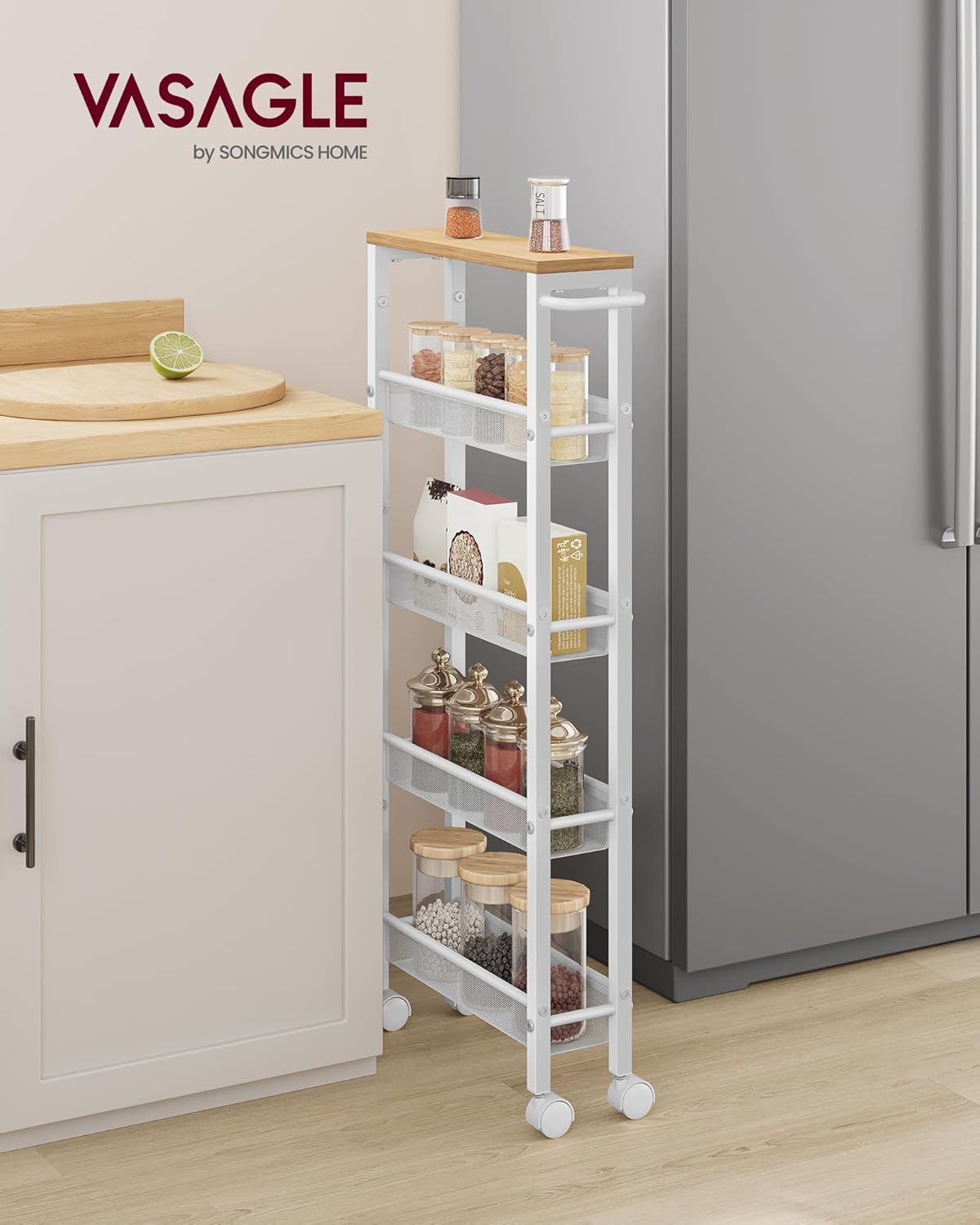
VASAGLE Slim 5-Tier Rolling Cart best fallback for a very narrow aisle
- Listed size: about 5.1 in. D x 17.9 in. W x 39.2 in. H.
- Why it fits: the narrow side can add vertical storage without using island depth.
- Watch: this is storage, not a stable chopping surface; its height can also interfere with windows, shelves, or outlets.
Use this only when the priority is reclaiming floor space and keeping ingredients or tools within reach. It is a better answer than a deep island when the walkway is already tight.
View on Amazon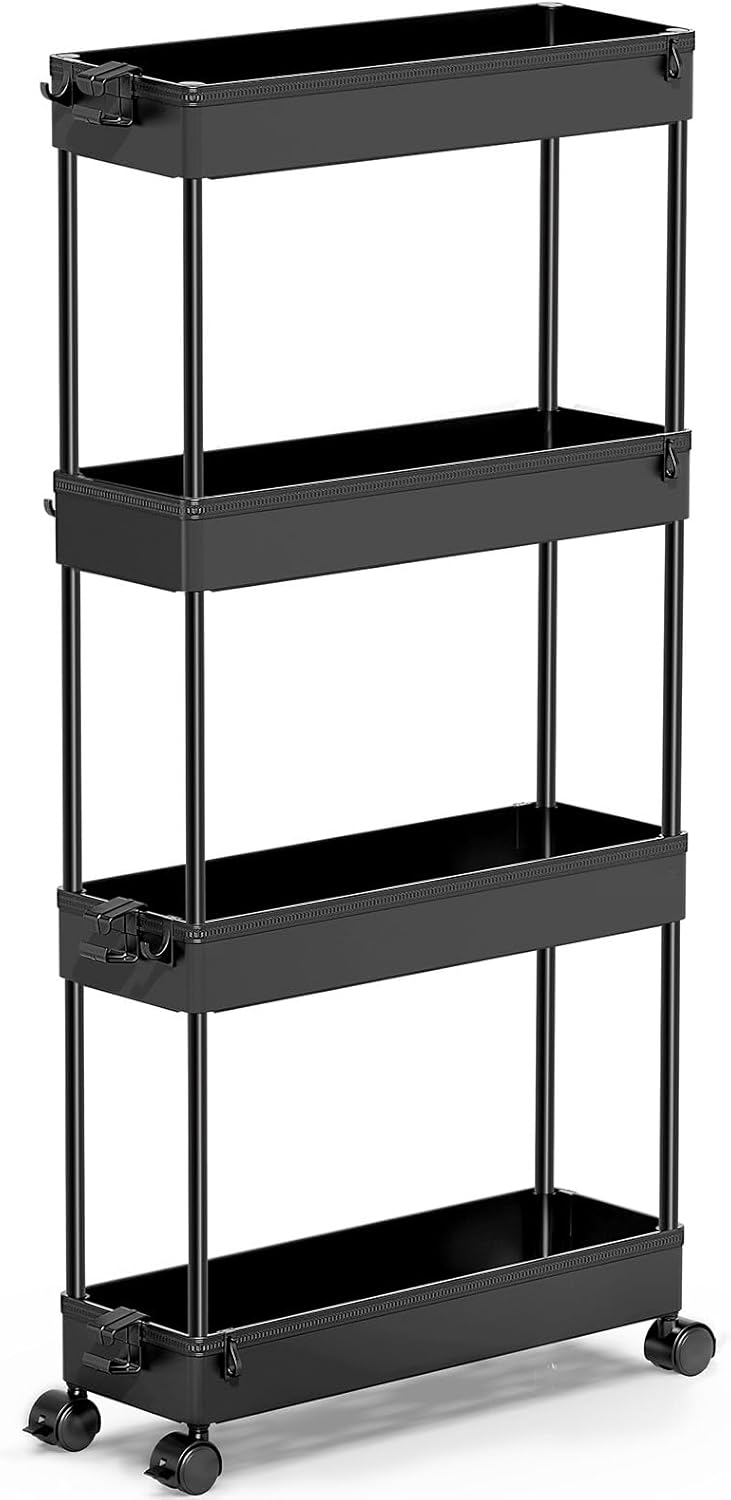
SPACEKEEPER Slim Rolling Storage Cart best for a narrow gap beside an island
- Listed size: about 4.9 in. D x 15.3 in. W x 38.7 in. H.
- Why it fits: a very shallow cart can use a leftover gap without claiming the main work aisle.
- Watch: the narrow shelves are for small items, not bulky cookware or a substitute worktop.
Choose this as a side-storage companion when the kitchen cannot spare 13 to 18 inches of island depth but still has a slim gap to organize.
View on AmazonFits if / skip if
| Option | Fits if | Skip if |
|---|---|---|
| Shallow open cart | You need movable storage and can keep the main work surface elsewhere. | You need drawers, enclosed storage, or a top wide enough for active prep. |
| Drop-leaf kitchen cart | The closed depth fits and the leaves can stay down during normal traffic. | The open leaves would block an appliance, doorway, or the only working aisle. |
| Ultra-slim vertical cart | The room cannot spare island depth and the storage items are small and light. | You want a stable cutting surface or need to store wide pans. |
| Any island near 18 inches deep | You have measured clearance on both sides and can still open every nearby door. | The 18-inch figure leaves no margin for overhangs, trim, casters, or uneven walls. |
Common fit mistakes
- Using the listed cabinet depth and forgetting the worktop overhang or caster width.
- Measuring only the island's parked position, not the space required to pull it out and walk around it.
- Opening the refrigerator or dishwasher only halfway during the test.
- Choosing a drop-leaf cart without checking where the leaf edge lands when fully open.
- Assuming wheels solve a clearance problem when the island still has to pass a doorway, rug, or baseboard.
- Placing a tall slim cart in front of an outlet, vent, window, or appliance control.
- Trying to use a narrow storage cart as a cutting surface when its shelves or frame can wobble.
FAQ
Is 18 inches deep enough for a kitchen island?
It can be, but only when the remaining aisle is comfortable and nearby doors can open fully. Treat 18 inches as a maximum footprint to test, not as proof that the island will fit.
How much space should I leave around a skinny kitchen island?
Measure the actual route between counters, appliances, and walls, then test the tightest point with doors and drawers open. The right clearance depends on the room and how the island will be used.
Are rolling kitchen islands better for small kitchens?
Often, because you can move them when the refrigerator, oven, or dishwasher is open. Lock the casters during use and confirm the island can roll over your floor without catching.
Do drop leaves make a shallow island less space-efficient?
They can. A drop leaf preserves a smaller parked footprint, but the open surface changes the island's width and the clearance required to work beside it.
What is the best alternative if an 18-inch island still blocks the kitchen?
Use a much slimmer vertical cart or a shallow wall-mounted shelf for storage, and keep prep space on the existing counter. A smaller solution that preserves movement is more useful than an island that must stay parked.