Quick verdict
For a narrow kitchen shelf under 8 inches deep, a rolling pantry cart is the most flexible choice when the opening is at least 5.5 to 7 inches deep and you can pull the unit fully into the room. A wall-mounted shelf is safer when the walkway is too tight for a cart, but it trades mobility for drilling, anchors, and a fixed load path.
If your measured gap is exactly 8 inches, shop closer to 6.5 or 7 inches deep. The spare room protects against baseboards, uneven walls, wheel housings, shelf lips, and the small amount of space needed to grip a handle and pull the shelf out.
Measure this before buying
- Smallest usable depth: measure near the floor, at shelf height, and at the top of the gap. Subtract baseboards, cabinet faces, trim, handles, and appliance controls.
- Opening width: a cart that is shallow enough can still fail at the entrance. Measure the narrowest width between the fridge, cabinet, wall, or counter edge.
- Pull-out clearance: mark how far the cart needs to come forward before you can see or reach the back of each shelf. Check that a drawer, appliance door, or walkway is not in that path.
- Top and bottom obstructions: check counter overhangs, outlet plates, pipes, floor transitions, and any ledge that changes the gap shape.
- Item depth: compare the shelf's usable surface with the bottles, cans, jars, or boxes you intend to store. A shelf can fit the gap and still be too shallow for the items.
- Wall structure: for a fixed shelf, locate studs or choose anchors for the wall type before relying on the listed load capacity.
Recommended Amazon products to check
These options show two different solutions: mobile shelves that slide into a gap and fixed shelves that use wall height. Re-check the selected size or tier variant on Amazon before checkout because a product page can contain several footprints.

Lavish Home 5-Tier Slim Rolling Cart best for the tightest floor gap
- Listed footprint: about 21.5 in. L x 5 in. W x 52 in. H.
- Why it fits: the five-inch side is built for gaps beside appliances and cabinets.
- Watch: tall rolling storage needs a stable, level floor and anti-tip judgment.
Choose this style when you need several shallow shelves for spices, packets, cleaning items, or small pantry goods. The narrow width is helpful, but the long shelf direction and full pull-out distance still need room in front of the gap.
View on Amazon
Lavish Home 3-Tier Slim Rolling Cart best when you need a shorter tower
- Listed footprint: about 19.5 in. L x 5 in. W x 28 in. H.
- Why it fits: the shallow footprint uses a gap without adding a tall tower above the counter line.
- Watch: each narrow shelf has limited usable depth for large bottles and boxes.
This is the more approachable version when a 52-inch shelf would be too tall or visually heavy. Use it for small jars, coffee supplies, snacks, or cleaning products, and confirm that the wheels can roll over your floor surface.
View on Amazon
Asgolion 4-Tier Slim Storage Cart best for a medium-height narrow gap
- Listed footprint: about 15.6 in. L x 5.9 in. W x 33.6 in. H.
- Why it fits: a roughly 5.9-inch profile leaves more tolerance than an exact 8-inch shelf.
- Watch: confirm the selected tier and color variant keeps the same footprint.
Consider this type when you want a few shelves without the height of a full pantry tower. It works best for lightweight, frequently used items that you can pull out without loading the top with heavy jars.
View on Amazon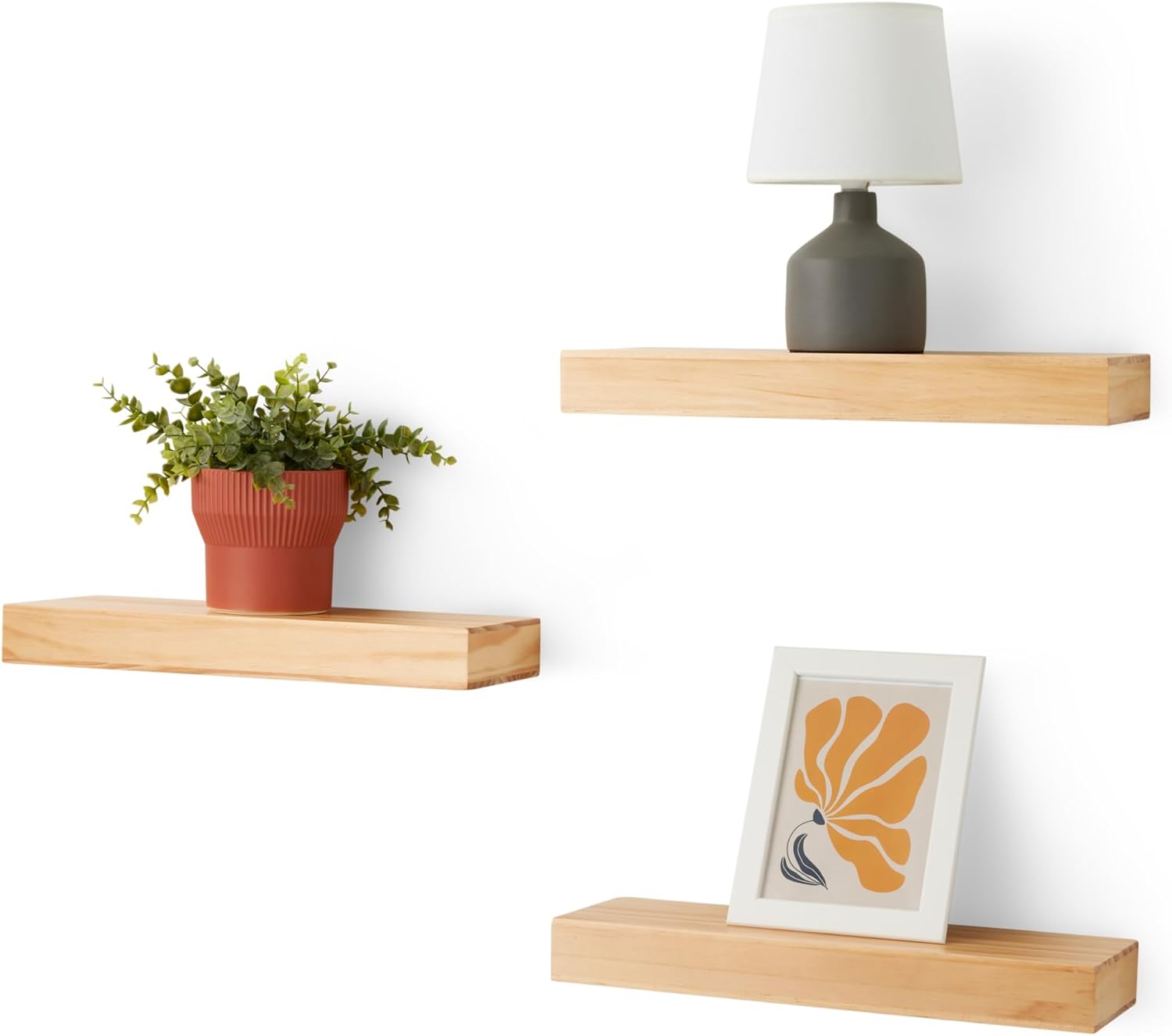
Amazon Basics Wood Floating Shelves best when floor clearance is the real problem
- Listed shelf size: about 15.8 in. W x 5 in. D x 1.8 in. H, three-pack.
- Why it fits: five-inch depth keeps the floor and walkway clear.
- Watch: wall anchors, stud placement, shelf height, and the depth of items placed on top.
Use a wall shelf when a cart would block a passage or cannot be pulled out. This is better for spices, mugs, small containers, and light pantry items than for heavy appliances or anything you need to move constantly.
View on AmazonFits if / skip if
| Option | Fits if | Skip if |
|---|---|---|
| 5-inch rolling tower | The gap is deep enough for the frame and wheels, and the full pull-out path is clear. | You cannot pull the cart forward without blocking a door, appliance, or walkway. |
| Short 3-tier cart | You want shallow storage below or near counter height. | Your items are deeper than the shelf surface or too heavy for a light plastic cart. |
| 5.9-inch rolling cart | You want more depth tolerance than an 8-inch shelf and do not need full pantry capacity. | The gap narrows at the back or the selected variant has a different footprint. |
| Wall-mounted shelf | Floor clearance is tight and the wall can safely accept the mounting hardware. | You rent without permission, cannot locate suitable anchors, or need to pull the shelf out. |
Common fit mistakes
- Using the product width as the depth because the listing orders dimensions differently.
- Measuring only at eye level and missing a baseboard or floor-level obstruction.
- Buying an 8-inch shelf for an 8-inch gap with no tolerance for walls or wheel housings.
- Forgetting the cart handle, shelf lip, or items that stick past the shelf edge.
- Choosing a tall tower without checking how it is stabilized on an uneven floor.
- Mounting a shelf into unsuitable drywall anchors and then storing heavy jars or appliances.
FAQ
What depth should I buy for an 8-inch kitchen gap?
Start around 6.5 to 7 inches deep when possible. A shelf listed at exactly 8 inches leaves no room for uneven walls, baseboards, wheel housings, or the items placed on it.
Is a rolling cart better than a wall shelf in a narrow kitchen?
A rolling cart is easier to access and reposition, but it needs a clear pull-out path. A wall shelf preserves floor space, although it requires secure mounting and keeps the items fixed in place.
Can a narrow shelf hold pantry cans and jars?
It can if the shelf surface, rim, and mounting or frame are rated for the load. Keep heavy items low on a rolling cart and verify wall anchors before loading a fixed shelf.
How much clearance does a pull-out kitchen shelf need?
Measure the cart's full length plus the space needed to stand in front of it and reach the shelves. A cart that technically rolls out but blocks a door is not a useful fit.