Quick verdict
For a pull-out organizer in a narrow base cabinet, measure the clear opening first, then check the organizer's outside width, depth, height, and slide clearance. A product described as “9 inches” may still need a wider opening once the rails, face frame, and hinge are included.
Use a low single-basket pull-out when the cabinet is short or the contents are light. Choose a two-tier unit only when the upper shelf clears the drawer above and the lower shelf still leaves room for bottles or pantry containers. If the cabinet is irregular, an expandable shelf may fit more safely than a fixed slide-out.
Measure this before buying
- Clear opening width: measure between the face-frame edges or hinges at the narrowest point. Do not measure the outside of the cabinet box.
- Interior width front to back: check the opening, middle, and back. A cabinet can taper or have a brace that steals the last fraction of an inch.
- Usable depth: measure from the front edge to the back wall, then subtract hinges, doors, plumbing, outlet boxes, or any obstruction that stops the organizer from sitting fully inside.
- Height below the drawer: measure from the cabinet floor to the lowest part of the drawer, stretcher, or countertop support above. Include the organizer, slide, and the tallest item you plan to store.
- Full pull-out path: mark the organizer footprint on the cabinet floor and extend it toward you. Confirm that the open shelf will not hit the door, adjacent cabinet, island, or your legs.
- Mounting surface: check whether the cabinet floor is flat and strong enough for the screws or whether the model needs side clearance for its rails. Avoid drilling into plumbing, wiring, or unsupported thin panels.
Recommended Amazon products to check
These examples cover low baskets, narrow two-tier organizers, L-shaped layouts, and an expandable alternative. Re-check the selected variant and listed dimensions on Amazon before checkout.

Simple Houseware Cabinet Basket best low pull-out for a narrow side
- Listed size: about 17 in. D x 9 in. W x 5.3 in. H.
- Why it fits: the low basket uses a narrow footprint and leaves more vertical room above.
- Watch: confirm the cabinet has enough depth for the basket and its slide path; skip it for heavy loads or a cabinet with a raised floor.
This is the simplest starting point when width is the hard limit and you want one low pull-out zone for small pantry items, bags, or cleaning supplies.
View on Amazon
REALINN L-Shaped Pull-Out Organizer best when one side of the cabinet is blocked
- Listed footprint: about 14.2 in. x 10.6 in.; listed height about 11 in.
- Why it fits: the L-shaped arrangement can keep one side open for an offset obstruction.
- Watch: the wider footprint needs more than a slim front opening; trace the entire pull-out path before mounting.
Consider this layout when a straight shelf would collide with a pipe, disposal, or other fixed object. It is a poor choice if the cabinet is narrow in both width and depth.
View on Amazon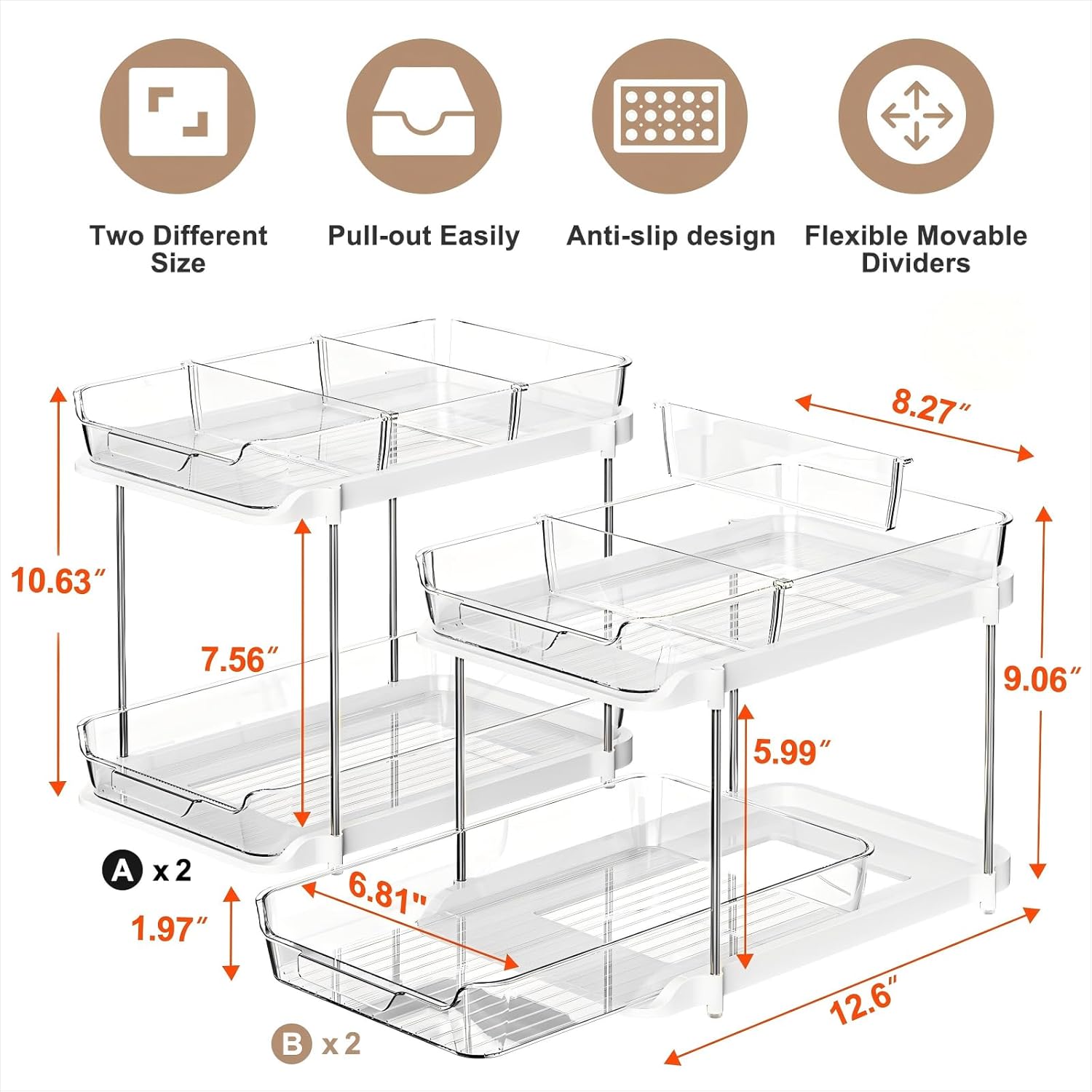
Delamu 2-Tier Clear Pull-Out Organizers best for a narrow opening with small items
- Listed large-unit size: about 13.19 in. D x 8.27 in. W x 10.63 in. H.
- Why it fits: the narrow width can work in a smaller opening than a wide base-cabinet drawer.
- Watch: two tiers are useful only if the upper tier clears the drawer above and the lower tier holds your tallest items.
Choose a two-tier format when the cabinet has enough height and you want visibility without reaching to the back. Measure the assembled unit, not only the individual baskets.
View on Amazon
Spicy Shelf Expandable Organizer best alternative when a fixed pull-out will not clear the cabinet
- Listed range: expands from about 16 to 20 in. W, 10 to 14 in. D, and 10 to 13 in. H.
- Why it fits: adjustable panels can adapt to an uneven cabinet or leave a central obstruction open.
- Watch: this is not a pull-out drawer; skip it if reaching to the back is the main problem.
Use an expandable shelf when the cabinet's usable width changes around an obstruction or when you want to avoid drilling into a narrow cabinet floor.
View on AmazonFits if / skip if
| Option | Fits if | Skip if |
|---|---|---|
| Low single-basket pull-out | The opening is wider than the assembled unit and the cabinet floor is flat. | You need to store heavy loads or the rail path is blocked by a hinge. |
| L-shaped pull-out | One side is clear and the cabinet has enough depth for the full footprint. | The cabinet is narrow in both directions or the obstruction sits in the slide path. |
| Two-tier pull-out | The upper basket clears the drawer above and your bottles fit below. | You are using the cabinet for tall containers or the ceiling height is the limiting measure. |
| Expandable shelf | The cabinet is irregular and you want adjustable width without a fixed slide. | You need the rear contents to come forward or the shelf would span a plumbing obstruction. |
Common fit mistakes
- Buying by the cabinet's nominal width instead of its clear opening.
- Measuring the cabinet floor but forgetting the face frame, hinges, or door thickness.
- Checking the organizer's closed dimensions but not the space needed when it is fully extended.
- Ignoring the drawer or stretcher above the cabinet and discovering that a two-tier unit cannot be loaded.
- Assuming a “9-inch” organizer includes the rails, handles, or side clearance in that number.
- Installing before dry-fitting the unit and tracing where screws, slides, and doors will move.
- Choosing a pull-out for a cabinet that is too shallow, then losing useful storage to the rear clearance.
FAQ
How do I measure a narrow base cabinet for a pull-out organizer?
Measure the clear opening at the front, the interior width at several points, the usable depth, and the height below the drawer or countertop support. Then compare those measurements with the assembled organizer and its full extension path.
Will a 9-inch pull-out organizer fit in a 9-inch cabinet?
Not necessarily. The cabinet label may describe the box, while the organizer needs clearance for rails, hinges, and the face frame. Use the manufacturer's minimum opening measurement and your own narrowest measurement.
Are two-tier pull-out organizers better for narrow cabinets?
Only when height is available and the upper tier does not collide with the drawer above. A low single basket is often easier to load when the cabinet is short.
What if the cabinet has an obstruction in the middle?
Measure around the obstruction and consider an L-shaped or expandable organizer. If the obstruction sits in the slide path, a fixed pull-out may not be the right layout.
Should I install the organizer before checking the door swing?
No. Dry-fit or tape the footprint first, open the door fully, and extend the organizer as far as the design requires. A shelf that fits inside the box can still stop the door from closing.