Quick verdict
For a slim recycling bin in a tiny kitchen, choose a rectangular or oval container that is narrower than the opening at its smallest point. A compact open-top bin is easiest to use for dry paper and cans. A lidded step bin works better when you need odor or pet control, but it needs extra room above and in front of the container.
If the bin will sit beside a cabinet or appliance, shop to the usable width after handles, baseboards, and uneven walls are included. If you need to separate multiple recycling streams, two small matching bins may fit better than one wide dual-compartment can.
Measure this before buying
- Smallest width: measure the gap near the floor, at the middle, and where the bin rim will sit. Use the smallest reading and leave a little side clearance.
- Usable depth: subtract the projection of baseboards, cabinet faces, appliance handles, outlets, and plugs. A bin that fits behind the opening may still stick too far into the walkway.
- Top clearance: check the height of a hinged lid, sensor lid, or removable rim. A counter overhang can make a lidded bin unusable even when the body fits.
- Front access: leave room to lift out the bag or inner bucket and to place bulky cartons inside. Measure the full pull-out path, not just the closed footprint.
- Sorting volume: compare the bin with the recyclables you actually collect. A very narrow container may fit beautifully but need frequent emptying if cardboard cannot be flattened.
Recommended Amazon products to check
These examples cover different ways to handle recycling in a small kitchen. Some are compact wastebaskets that can be used for dry recyclables rather than dedicated outdoor recycling carts. Re-check the selected size, color, and dimensions on Amazon before checkout.

EKO 10L Small Step Bin best narrow lidded option
- Listed size: about 13.8 in. L x 6.6 in. W x 13.9 in. H.
- Why it fits: the narrow body works for a small dry-recycling stream beside a cabinet or vanity.
- Watch: the pedal and lid still need front and top clearance.
Pick this style when you want a removable inner bucket and a closed look in a narrow slot. It is better for cans, bottles, and small paper than for large cardboard unless you break the cardboard down first.
View on Amazon
simplehuman Compact Slim Step Bin best for a polished secondary station
- Listed size: about 14.2 in. L x 6.6 in. W x 13.3 in. H.
- Why it fits: a predictable rectangular footprint is easy to compare with a narrow gap.
- Watch: the small capacity makes it a secondary recycling bin, not a whole-house sorter.
Use this type when the bin will stay visible near a coffee station, prep area, or small apartment kitchen. The foot pedal is convenient, but make sure you can press it without hitting the cabinet or appliance beside it.
View on Amazon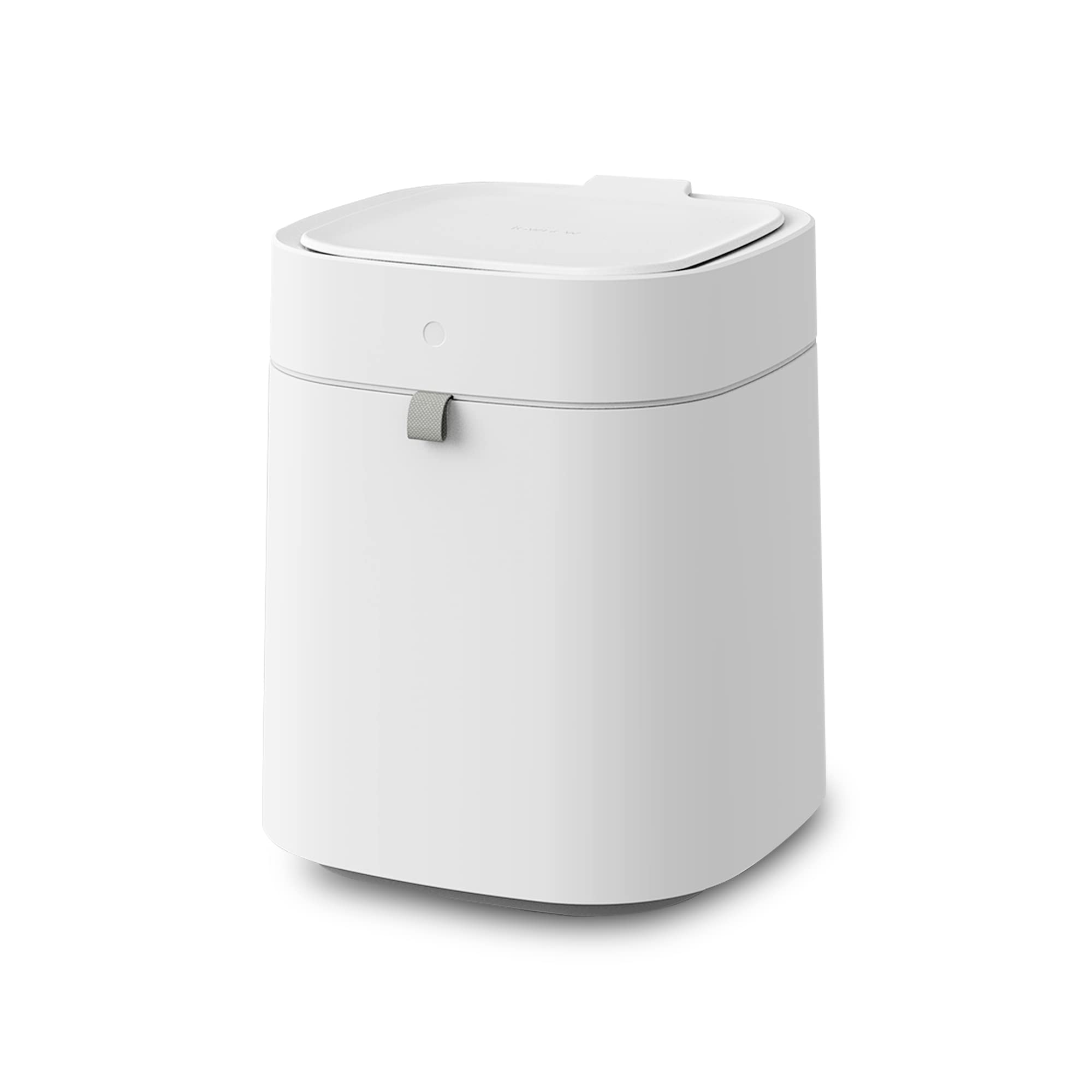
TOWNEW T Air X Slim Smart Bin for a roughly 9-inch width limit
- Listed size: about 13 in. L x 9 in. W x 13 in. H.
- Why it fits: stays below a 10-inch width target while keeping the top enclosed.
- Watch: sensors, charging, and a proprietary bag system add more checks than an open bin.
Consider this only when the extra features solve a real problem, such as keeping a small recycling stream enclosed. Skip it if you want to use ordinary liners or drop in large cartons without a lid-opening routine.
View on Amazon
HMQCI Small Open-Top Wastebasket best for dry, low-volume recycling
- Listed size: about 7.7 in. L x 7.7 in. W x 10.2 in. H.
- Why it fits: no lid, pedal, hinge, or sensor zone to add to the access calculation.
- Watch: the round footprint wastes corner space and does not hide odors or contents.
This is the simplest choice for a small paper, can, or bottle collection beside a desk, coffee station, or prep area. Use a liner and empty it often; it is not a substitute for a large household recycling container.
View on AmazonFits if / skip if
| Option | Fits if | Skip if |
|---|---|---|
| Narrow lidded step bin | You need a contained recycling stream and have room for the pedal, lid, and bag removal. | The bin will sit under a counter or in a gap where the lid cannot open. |
| Compact rectangular step bin | You want a visible secondary station with a predictable footprint. | You need to collect flattened cardboard or a full family's recycling in one container. |
| Slim smart bin | You accept the battery, sensor, and liner requirements and have a clear top zone. | You want the simplest low-maintenance recycling setup. |
| Open-top micro-bin | Your recycling is dry, light, and emptied frequently. | You need odor control, pet resistance, or room for bulky packaging. |
Common fit mistakes
- Measuring the front opening but not the narrower back of the gap.
- Confusing a product's length or depth with its narrow side width.
- Ignoring the lid height, pedal travel, or sensor activation area.
- Choosing a round bin for a square corner and losing usable volume.
- Buying to the exact gap width, then finding that the bag bulges past the rim.
- Forgetting that cardboard, milk jugs, and bottles need a wider opening than cans.
FAQ
What is the best shape for a slim recycling bin?
A straight-sided rectangular bin usually uses a narrow kitchen gap better than a round bin. Choose an open top when large recyclables are the problem and a lid when containment matters more.
How much smaller should a recycling bin be than the gap?
Try to leave about half an inch on each side when possible. Buy to the smallest measured width, not the widest point of the opening.
Can I use a small trash can as a recycling bin?
Yes, for a dry, low-volume stream such as cans, bottles, or paper. Check the opening size and capacity before assuming it can handle flattened boxes or large containers.
Is one slim bin better than two small bins?
Not always. Two narrow matching bins can fit separate waste streams into two gaps, while one wide dual-compartment unit may need more width and front clearance.